Times are tough for electric vehicles, in part because prospective EV buyers can no longer get the $7,500 tax credit that helped to offset the higher buy-in cost versus an otherwise similar vehicle with an engine rather than a battery pack.
But that is only part of the reason why.
Another one is the now well-known range issue, which is really a charge-time issue. It is one thing to have a vehicle that can only go 250 or so miles before it needs to be charged up again. The more fundamental problem is the time it takes to recharge.
That can be compensated for by increasing the fully charged driving range — which is what Hyundai hopes will get people reluctant to buy an EV to consider buying the new Ioniq 9.
What It Is
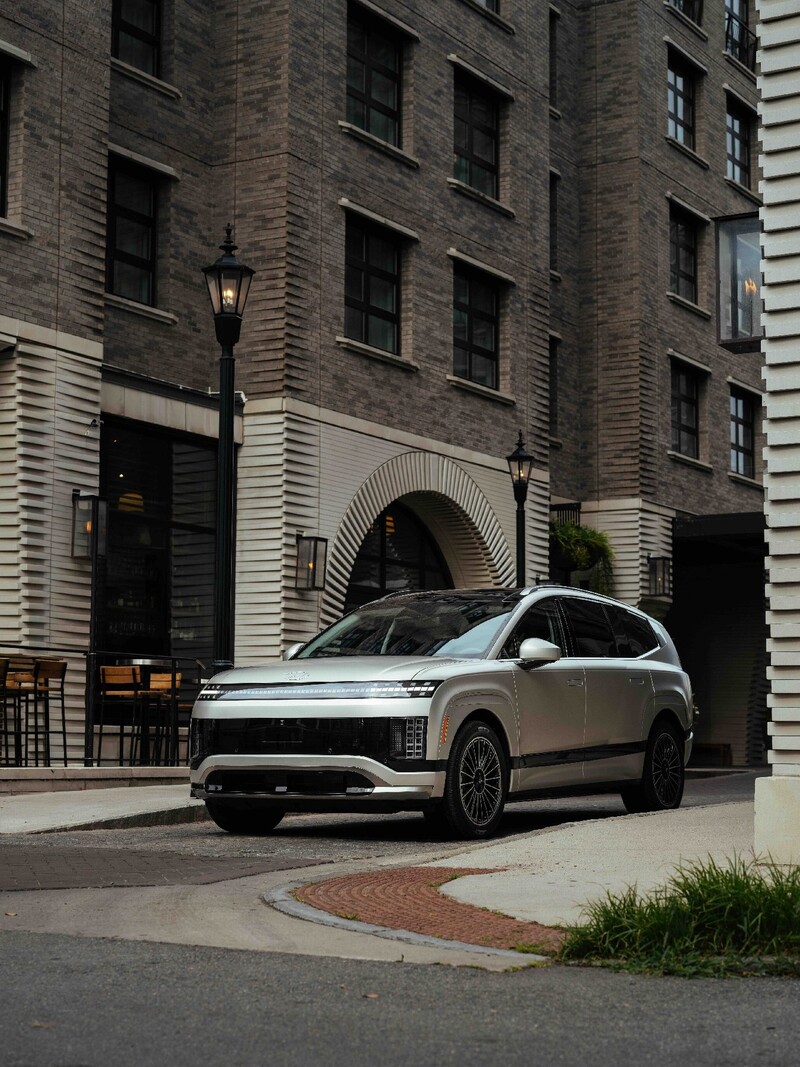
The Ioniq 9 is a medium-large, three-row crossover similar to Hyundai's Palisade. In fact, both are exactly the same size and look closely related. But they are very different in terms of their drivetrains.
While the Palisade comes standard with a 3.5-liter V6, the Ioniq 9 comes standard with a 110-kWh battery pack. You can pick single motor, which gets you rear-wheel drive, or dual motor, which gets you all-wheel drive — as well as a bump in power from 215 horsepower to 303. There is also a high-performance setup that bundles a pair of more powerful motors (422 horsepower) with AWD.
The RWD/single-motor version S stickers for $58,995 and touts 335 miles of driving range; the dual motor setup that's standard in the SE ($62,765) and SEL ($66,320) trims have a claimed 320-mile driving range. Performance ($71,250) and Calligraphy ($74,990) and top-of-the-line Performance Calligraphy Design ($76,490) trims with the high-performance dual-motor setup and AWD tout 311 miles of fully charged driving range.
What's New for 2026
The Ioniq 9 is a new EV just added to Hyundai's model lineup.
What's Good
— No extra charge for additional range. (Many other EVs come standard with less range than the more expensive trims.)
— Room for adults in all three rows.
— Advertised range is realistic driving range.
What's Not So Good
— As with any EV, you still have to keep track of range remaining — and make time for recharging.
— This EV cannot be charged using a Level I (120V ordinary household) outlet, which means you have to get a Level II (240V) outlet wired up at home or use commercial fast chargers.
— At almost $60,000 to start, the Ioniq costs about $20,000 more to start than the otherwise similar Palisade; it's doubtful you'll save enough on what you didn't spend on gas to make up for what you spent on the vehicle.
Under the Hood
As mentioned, every Ioniq 9 — irrespective of motor count or horsepower — comes standard with the same 110-kWh battery pack. What's arguably most interesting about this Hyundai EV is that you get the most range with the standard (S) trim. In other words, Hyundai doesn't tout a long-range iteration that costs extra.
If you want more power — or AWD — both are available, at the cost of some (but not much) range.
The take-home point is, you don't have to buy either if you just want the max-range version of this EV.
This was smart of Hyundai, since it is probably true that the majority of people who might be shopping for a vehicle of this type are not chiefly looking for how quickly it gets to 60 mph but practicality. It is, after all, fundamentally a family-type vehicle.
It is also nice that Hyundai doesn't bundle the AWD setup with the high-performance dual-motor setup, once again because AWD is a desirable feature in a family-minded vehicle such as this.
An interesting thing about this EV is that it can only be charged one of two — rather than the usual three — ways.
Most EVs can be charged — slowly — via plugging them in to any common household 120V outlet, which has the upside of being able to plug in anywhere there is electricity. The downside is that it takes a long time to recover any significant charge this way; typically, you'll get about 30 miles' worth of range overnight.
You don't get this option with the Ioniq 9.
It can only be charged at a commercial fast charger or at home by plugging it into a Level II (240v) outlet that generally requires adding the circuit to your home's electrical panel. This may require upgrading your home's electrical panel, if your home is older and the panel you have hasn't got capacity to add a 240v (and typically, 30 amp) circuit. You also have to have a home. People who live in apartments or who rent may not be able to Level II charge, effectively forcing them to drive to a commercial fast charger.
On the upside, Hyundai does provide a universal adaptor for the charge port that enables the Ioniq 9 to be charged at pretty much every commercial fast charging kiosk — including Tesla "superchargers." Some EVs have brand-specific charge ports that do not work with some fast chargers.
On the Road
If you didn't know it was electric, you might not be able to tell it is.
Well, unless you floor it. If you do, you'll get to 60 mph in just over four seconds in the versions with the high-output dual-motor setup.
Hyundai has done an excellent job of making the Ioniq 9 feel reassuringly normal. Yes, it is quiet — just like the Palisade is. Just as most new vehicles are. Vehicle manufacturers have done a remarkable job of making even vehicles like the Palisade that have engines nearly as silent-running as electric vehicles. The most noticeable difference is the instant forward thrust, which continues linearly as long as you keep your right foot pressing down on the accelerator pedal. There is no sense (or sound) of shifting, because there is no shifting — because there is no transmission. The electric motor(s) directly connect to and drive the wheels.
The main thing is the same thing that comes standard with every EV: keeping track of how much range you've got left.
One of the interesting things about this EV is that Hyundai gives you a spectrum of range remaining. There's the maximum, the minimum and the likely, which are updated by the computer as you drive. The maximum assumes mostly low-speed driving on flat roads in temperate conditions — i.e., not too hot and not too cold — so less energy is consumed by accessories such as the heater or AC. The minimum assumes continuous high-speed driving and use of electrically powered accessories.
The likely is what you're likely to see most of the time. It is a realistic indicator of how far you can actually drive, in other words.
At the Curb
The Ioniq is — arguably — what the Volkswagen ID Buzz ought to have been. Both are large vans, basically — with room inside for a large family or just a large number of people. The difference is the VW — which has been "temporarily" canceled for 2026 — didn't have enough range (just 250 miles, best case) to make it practical for a family. The same issue detracts from the Ioniq 9's slightly smaller, Kia-badged cousin — the EV9. That one comes standard with just 230 miles of range.
The Ioniq 9 also feels more luxurious. More finely, it doesn't feel or look like it ought to cost $30,000 rather than almost $60,000 (as the ID Buzz — which has an almost startlingly spartan-looking interior — does).
This Hyundai comes standard with LED headlights, rain-sensing wipers, seat heaters, wireless charging and seven of the new-style USB-C charge ports, plus dual 12.3-inch LCD touch screens. Also standard is a sliding center console that can be slid rearward.
Certain desirable features such as the sunroof and heated steering wheel are, however, not available with the base S or the next-highest SE trim. You have to step up to the SEL to get the heated steering wheel (and ambient interior lighting), and if you want the sunroof, you'll have to buy the Limited. If you do, you'll also get the upgraded 14-speaker Bose premium stereo that's not available with the lower trims.
Massaging "relaxation seats" are also available.
The Rest
A neat feature we probably won't get in this country are second-row seats that can turn to face the third-row seats, creating a kind of mobile lounge for passengers. This feature will likely not be available in this country because of federal "safety" rigmarole.
The Bottom Line
The difficulty Hyundai may have selling this EV is that buyers might cross-shop the Palisade and decide that spending $20,000 more to get into something that's otherwise similar (sans the engine) might not be worth doing. On the other hand, the Ioniq 9 is at least plausibly practical — on account of its standard and realistic 300-plus miles of fully charged range and the fact that it's also a nice place to spend time in.
Even if you're just sitting at a fast-charge kiosk waiting to get going again.
Eric's latest book, "Doomed: Good Cars Gone Wrong!" will be available soon. To find out more about Eric and read his past columns, please visit the Creators Syndicate webpage at www.creators.com.
View the Hyundai Ioniq 9 this week.







View Comments